
# Search
There are two ways to search. The search bar at the top of the app is always there, from any page. The full Search page lives under Archive → Search and adds advanced search on top of it.
Video tutorial
Watch the tutorial Die swiDOC Suche richtig nutzen (opens new window) on YouTube.
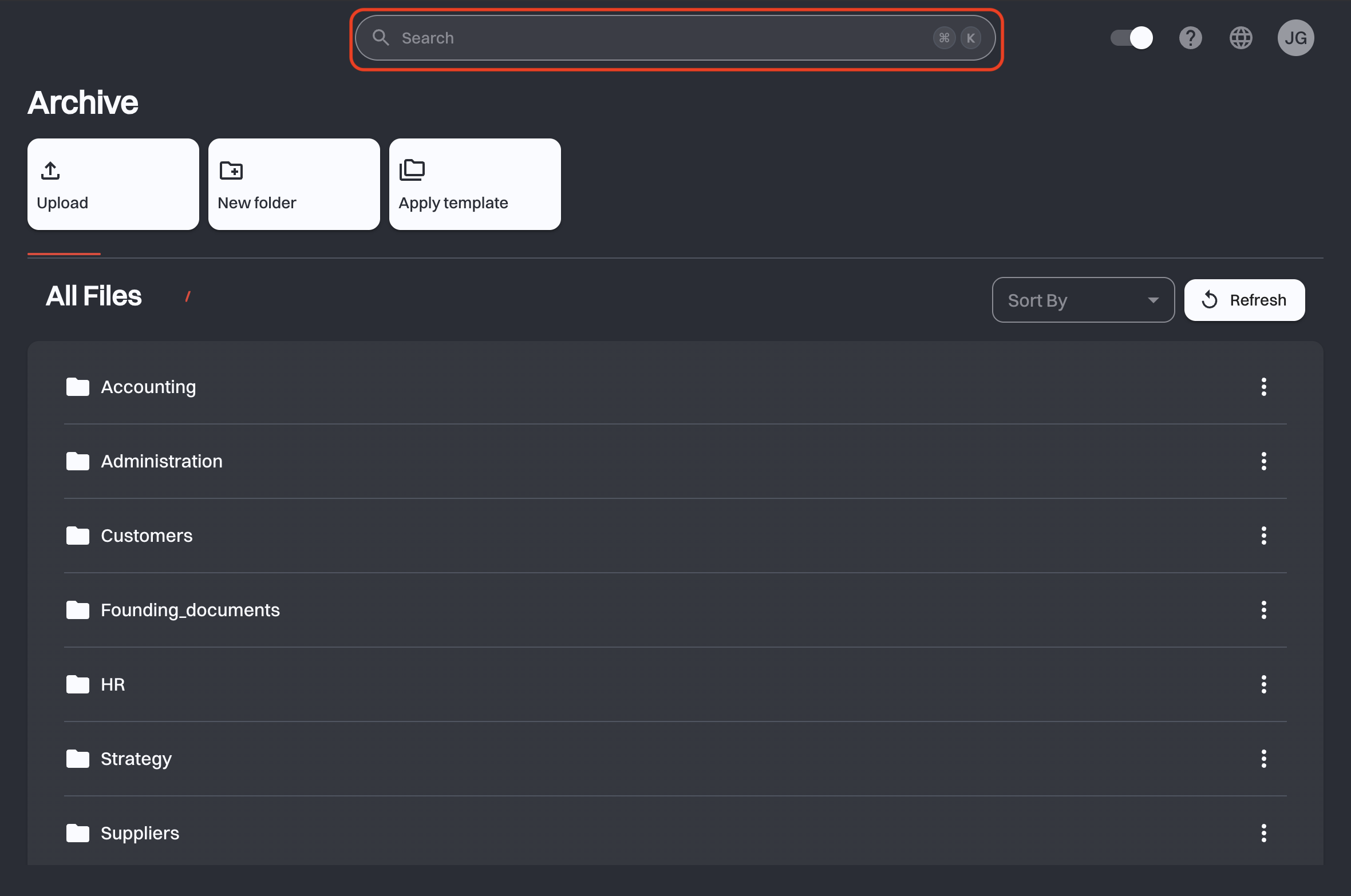
On a desktop you can open the search bar with ⌘ + K (macOS) or Ctrl + K (Windows and Linux) instead of clicking it.
# Smart search
Search does not only look at the file name of your archived documents. It also covers descriptions, folder paths, tags, search attributes and the text inside your documents.
Press Enter, or click the magnifying glass at the start of the field, to run the search.
Each result shows the document's name, its folder path, and the date and person it was archived by, so you can tell two similarly named documents apart without opening either. All Results takes the same search term and the order you picked over to the Search page, where the full list is shown.
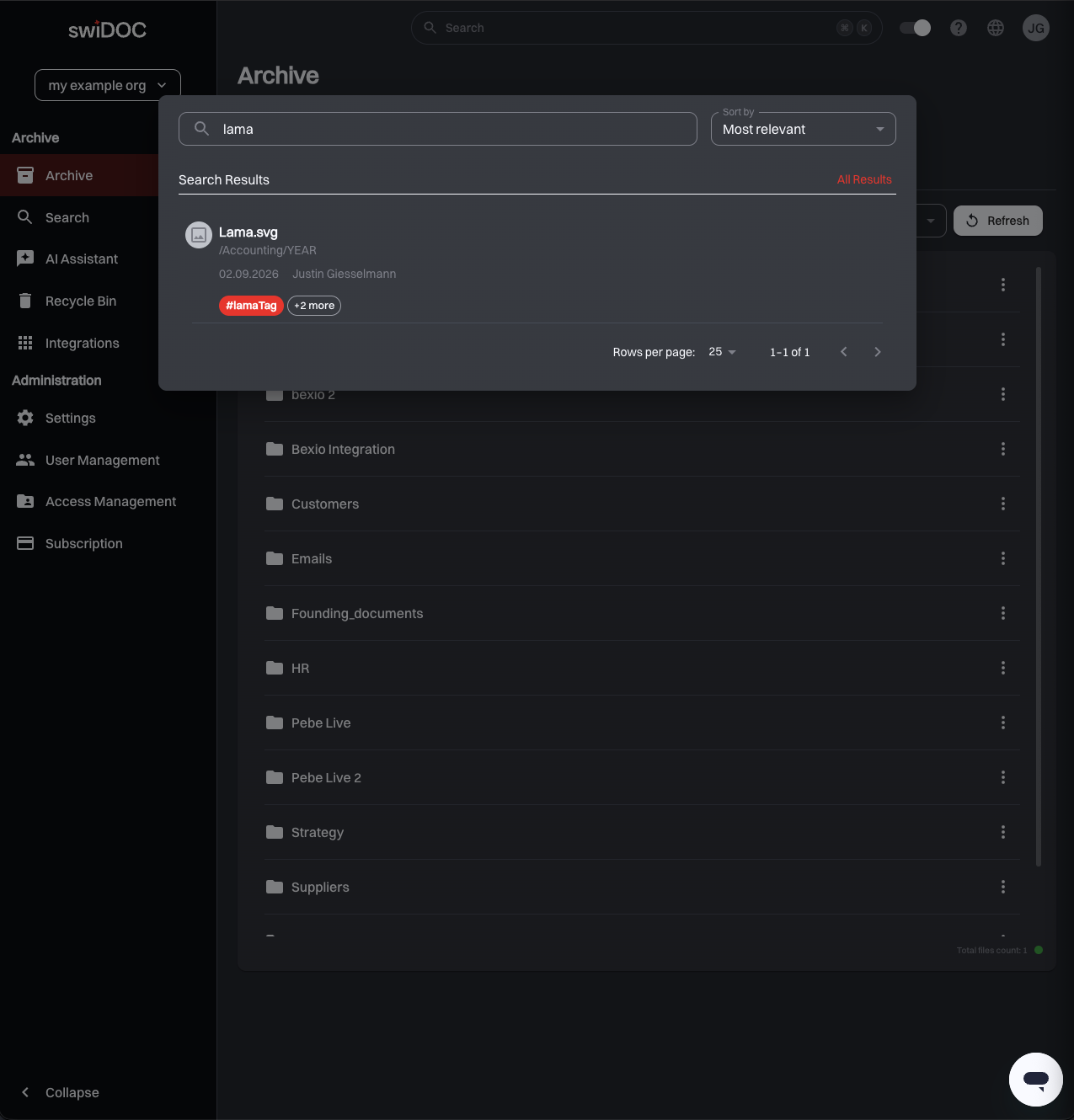
# Search examples
- You can type the beginning of a word.
rechfindsRechnung, but notVerbrechen: matching is anchored to the start of a word. Terms shorter than three characters are ignored, because they match almost everything. - Typos are tolerated. From four characters onwards, one wrong or transposed letter still finds the
document. Numbers are matched exactly, so
2024never returns2023. - Word forms are matched, in German, English, French and Italian at the same time, so there is
no language setting to get wrong:
invoicesalso findsinvoice. German compounds are split as well, sorechnung(invoice) also findsSchlussrechnung. Accents are interchangeable with their plain spelling, socafealso findscafé. - Several words narrow the search. Every word you type has to match, but they may match in different places: one in the file name and one in the document text is a hit.
Search never returns documents from folders you cannot access, so what you find is what you are allowed to open. See Access Management for how those restrictions are set.
# Text recognition (OCR)
Every document is analyzed automatically when you upload it. OCR (optical character recognition) reads the text out of your documents and makes it searchable.
In practice this means you are not limited to text files: a photographed receipt or a scanned contract is just as findable as a Word document, including words that appear nowhere in the title or the metadata.
Long documents are not read to the end
Text extraction stops after roughly the first 25,000 characters, which is about ten to twenty pages depending on how much text each page carries. On documents longer than ten pages, the pages it reads are sampled rather than taken in order. A word buried deep in a long document may therefore not be findable.
For long documents, good tags and a clear folder structure are what keep things findable.
# Advanced search
Advanced search searches specific attributes instead of everything at once. On the Search page, open it with the filter icon next to the search field.
Each condition is a row with three parts:
| Part | What you choose |
|---|---|
| Name of the Search Attribute | File Name, Path, Tag or Description, plus every search attribute your organization has defined. |
| Operator | is exactly or contains. |
| Search Value | What to look for in that attribute. |
The two operators are the whole point of the feature:
- is exactly: only documents whose value for that attribute matches the search term exactly.
- contains: every document that has the term somewhere in that attribute.
Use + to add another condition and the bin icon to remove one. A document has to satisfy every condition to appear in the results, so each row you add narrows the result set rather than widening it. Press Search to run it.
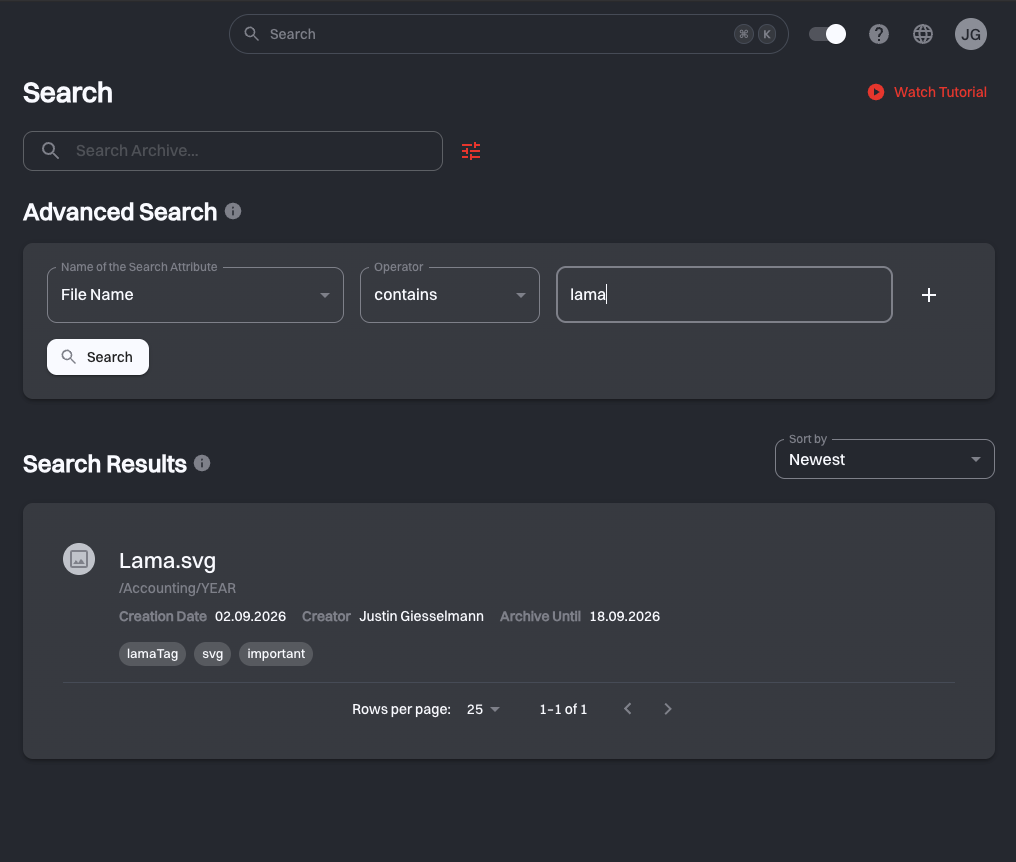
Results list each document's Creation Date, Creator and Archive Until date. On a large archive this is usually much faster than scrolling through folders.
Make search work harder
Two things pay off on a growing archive: define search attributes for the information you care about, and tag documents consistently as you upload them. Both are searchable, and both survive a document being moved.
You can also create and populate search attributes programmatically. See the swiDOC API.
# Sorting results
Sort by sets the order of the results. In the search bar it sits to the right of the search field. On a phone the search bar fills the screen and the dropdown sits below the field. On the Search page it sits in the header of the Search Results card.
| Option | Order |
|---|---|
| Most relevant | The best match for your search term first. This is the starting order for smart search. |
| Newest | The most recently archived document first. This is the starting order for advanced search. |
| Oldest | The earliest archived document first. |
# Exploratory search
Every result carries its tags and search attributes as chips under the file name. The ones that produced the match are highlighted, the rest sit behind a +2 more chip. Open it to see everything the document carries, and Show less folds the list back.
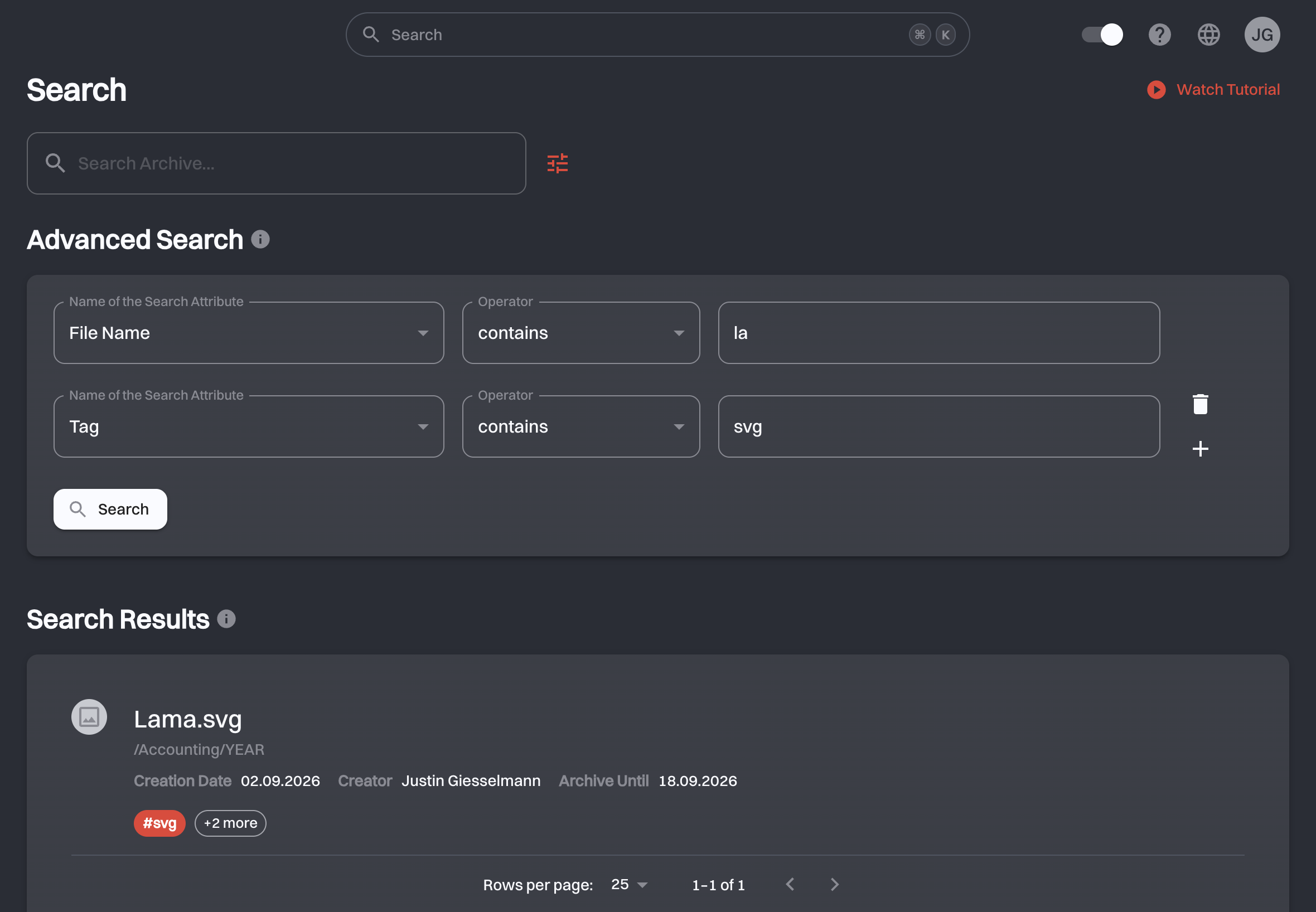
A chip is also a search. Click one and it replaces the query with a single condition on that tag or that attribute value, and runs it. Hover a chip to see Search for this. A chip that is already the whole query is inert, because clicking it would return the same results.
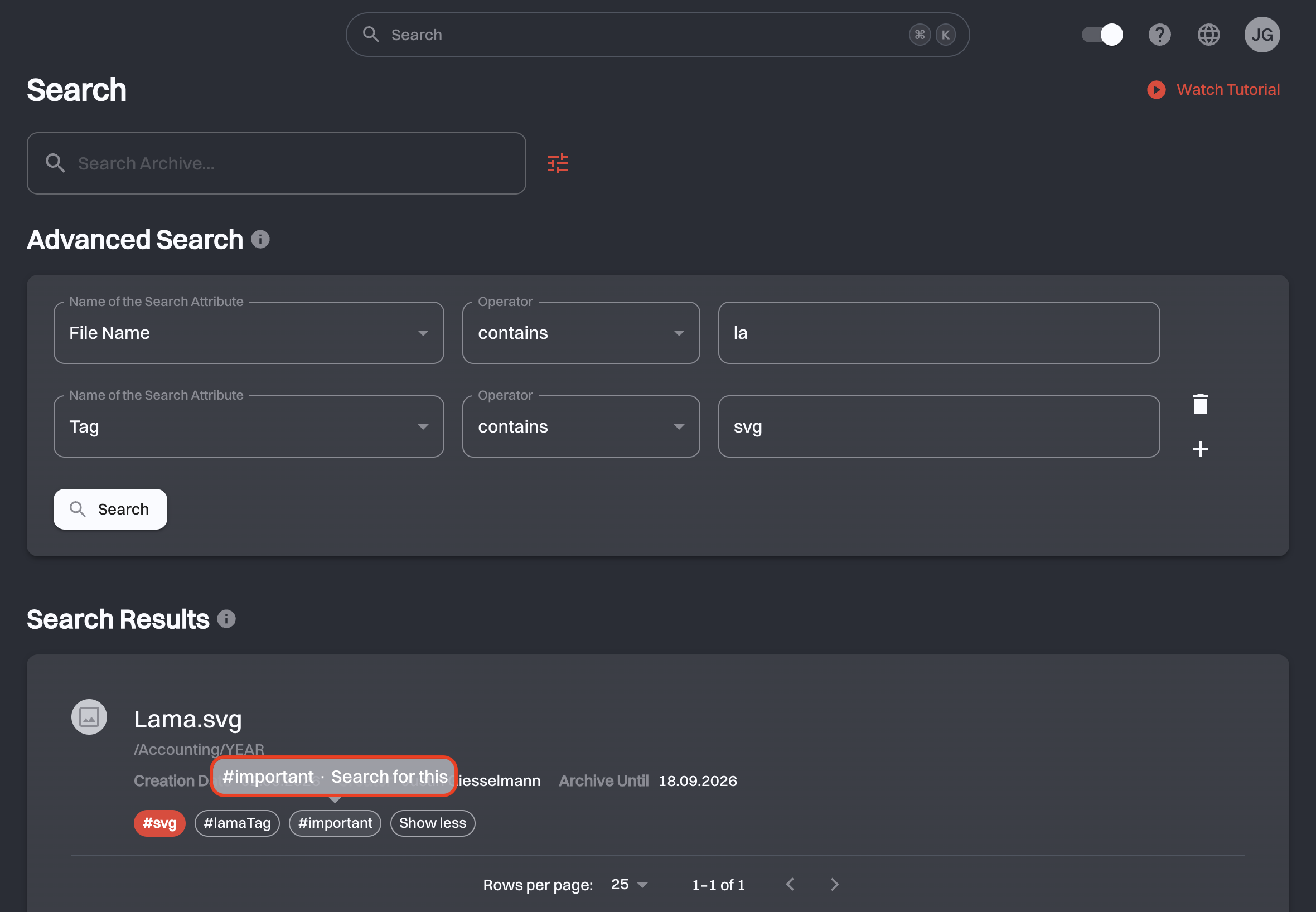
To search by tag without a result in front of you, use advanced search: choose Tag as the attribute, contains or is exactly, and the tag as the value.
# Related
- AI Assistant: ask questions about a document instead of searching for it.
- Settings: defining the search attributes advanced search offers.
- Access Management: why someone else's results differ from yours.
← Archive AI Assistant →