
# Integrations
Integrations connect swiDOC to the systems you already work in, so documents reach your archive without anyone having to upload them by hand.
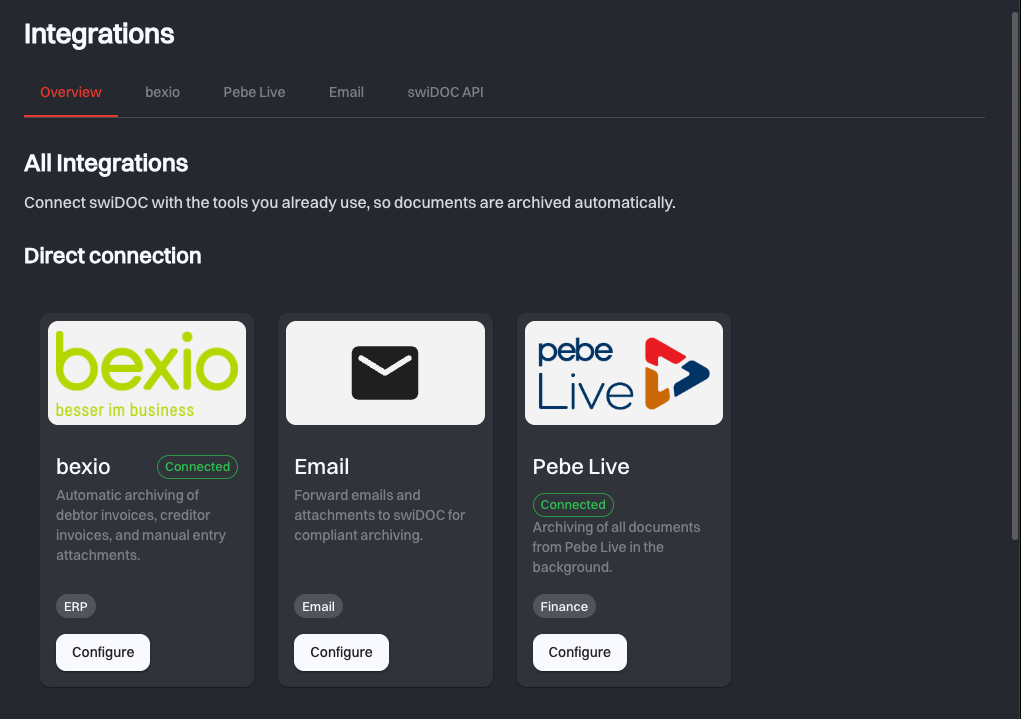
You find them under Archive → Integrations. Each direct connection has its own tab:
| Tab | What it is for |
|---|---|
| Overview | The catalogue of ready-made connections, grouped by how they connect |
| bexio | The bexio connection |
| Pebe Live | The Pebe Live connection |
| The email integration | |
| swiDOC API | Your API key, for Zapier, the partner tools and your own software |
Which tabs you see depends on your role and your package.
# swiDOC API
An API is an interface that lets two systems talk to each other directly. Your software makes a request ("archive this document") and the API carries it out, with nobody clicking anything.
Use it to automate archiving, and to connect swiDOC to systems that have no ready-made integration.
# Get your API key
Your API key authenticates every integration that is not a direct connection: Zapier, the partner tools and anything you build yourself.
The key is personal: requests made with it act as you. Only the Creator and Administrator roles have the swiDOC API tab and a working key (what each role can do).
Open Archive → Integrations, go to the swiDOC API tab, and click Show API Key. The key appears in a dialog, with Copy API Key next to it.
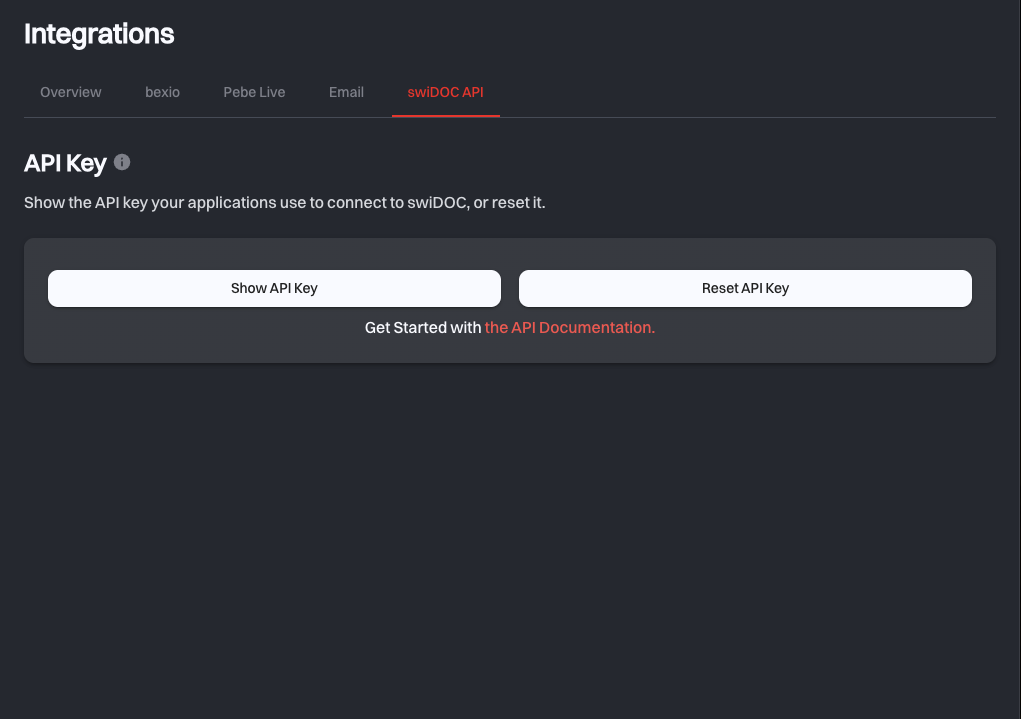
Reset API Key invalidates every key you were shown before. Click Show API Key afterwards to get a new one. Everything still using an old key stops working the moment you reset, so update your integrations in the same sitting.
Treat the key like a password
Anyone holding your API key can archive documents into your organization. Do not share it or commit it to a repository. If it may have leaked, reset it.
# What you can do with it
- Upload documents directly into your archive.
- Download documents by their file ID.
- Manage documents: update metadata such as descriptions and tags, or move documents between folders.
- Build integrations with systems swiDOC does not connect to out of the box.
# Full reference
There are two versions of the API. Use v2 for anything new. v1 is the earlier version and its endpoints differ, so a v1 call does not carry over unchanged.
Base URLs, endpoints, parameters and examples are in the API documentation, which is always current: api.docs.swidoc.ch (opens new window).
# All Integrations
The Overview tab, titled All Integrations, groups the catalogue by how each connection is made. Which cards you see depends on your package and your organization's settings, so a card described here may not appear for you.
# Integrated into your software
These tools archive to swiDOC from inside their own interface. You set them up in the partner's product, using your swiDOC API key where one is asked for.
| Integration | How it connects |
|---|---|
| Zapier (opens new window) | Connect swiDOC to thousands of other apps without writing code |
| infinity.swiss (opens new window) | Archives everything from infinity.swiss in the background |
| Blond (opens new window) | Archives everything from Blond in the background |
| MILKEE (opens new window) | Archives everything from MILKEE in the background |
| Pfeffersack (opens new window) | Archives everything from Pfeffersack in the background |
| ArchiveNinja (opens new window) | Pulls receipts and invoices out of your accounting software and archives them in swiDOC |
| Business Central (opens new window) | Connects your Microsoft Dynamics 365 Business Central installation |
# Direct connection
swiDOC talks to the other system itself. You connect once, then choose the destination folder and the archiving duration for everything that arrives, which are the same settings as a manual upload, applied automatically. See Archive for what those durations mean.
The bexio and Pebe Live cards show Connected while the integration is connected, and Sync stopped after swiDOC stopped syncing because of a problem. The integration's page says what to do.
# bexio
Video tutorial
Watch the tutorial Digital und rechtskonform unterwegs mit swiDOC und bexio (opens new window) on YouTube.
swiDOC signs in to your bexio (opens new window) company, reads its accounting documents and archives them. swiDOC only reads from bexio and never changes anything there.
Configure on the bexio card, or the bexio tab, opens the bexio page. Until bexio is connected and set up, the page shows a setup in four steps. You go through the same steps again after a disconnect or when bexio access expired, with the values from your previous setup filled in.
- Connect bexio: the step lists the access swiDOC asks for (Invoices and accounting, Files and attachments, and Stay signed in so that syncs run without you). Continue to bexio sends you to bexio to sign in and allow it. Sign in with a bexio user who can see every document you want to archive: swiDOC sees exactly what this user sees.
- What to archive: under Archive documents from you choose the start year, based on the document date in bexio. You can go back up to twelve years, and a first setup starts at the earliest year. The four Document types are always included: Customer invoices, Supplier bills, Expenses and Manual-entry attachments. Draft invoices are skipped.
- Where to store: choose the Destination folder and how long to Keep documents for. swiDOC puts the documents into sub-folders by company, type and date inside that folder. Restricted folders cannot be chosen. The retention period is counted from each document's date and is 10 years unless you change it.
- Review and start: check your choices, use Change to go back to a step, then click Start syncing (Save and resume syncing if bexio was set up before). Document types has no Change and shows Always included.
Connecting alone archives nothing. The first sync starts about 15 minutes after the last step, and you can leave the page in the meantime. After that, swiDOC checks bexio about once a week. An early start year means a longer first sync, because a large backlog is spread over several syncs.
# Follow the sync
Once the setup is finished, the bexio page shows how the connection is doing:
- Status: Active, Active, with warnings, Action needed or Syncing now, with the bexio company and the member who connected it.
- Last sync, Next sync and Archived so far: when the last sync ran, its result and document count, when the next one is due, and how many documents (and how much storage) bexio has archived in total. If Next sync says Not scheduled, no sync runs on its own. Click Start syncing to schedule one.
- Sync settings: the start year, destination folder, retention period and document types, and who changed them last.
- Sync history: one row per sync with its date, result, documents and size. Click a row to see the counts per document type and the problems of that sync. With issues shows only the syncs that failed or completed with warnings, and Show more loads older syncs.
Edit settings makes the sync settings editable in place, and Save changes applies them from the next sync on. Documents that are already archived are never moved or changed: a new destination folder only receives new documents, and a new retention period only applies to newly archived ones. An earlier start year adds the older documents in the next syncs. A later one keeps what is already archived.
# When a sync has a problem
If the last sync reported problems, they are listed right below the status, under Action needed, or under The last sync finished with warnings if none of them stops syncing. Each problem says what happened and what to do, usually with one button:
| Button | When it appears |
|---|---|
| Reconnect bexio | bexio rejected swiDOC's access, the bexio user may not read a document type, or setup is unfinished |
| Upgrade plan / Change start year | Your package has no space for the documents waiting in bexio, so syncing stopped |
| Choose folder | The destination folder was deleted or moved into a restricted area |
| Contact support | An unexpected error on swiDOC's side. swiDOC tries again in the next sync |
bexio rejects swiDOC's access when the bexio user who connected it changed their password, lost access to the company or removed the app in bexio. In that case, and when the package stays too small after several attempts, swiDOC disconnects bexio and the page shows the setup again, with a note on why syncing stopped.
Some problems need nothing from you, for example when bexio was not reachable, a single document could not be downloaded, or a sync reached its time limit (Not everything was archived in this sync): swiDOC tries again in the next sync. Technical details for support shows a code and a reference, which you can Copy into a support request.
When a problem stops syncing, swiDOC also sends an email to the member who connected bexio and to the member who created the organization, if they are still members. The email names the reason and links to the bexio page. It is not repeated after every sync while the same problem remains.
# Switch account or disconnect
Switch account sends you to bexio to sign in with a different user or company. Syncing pauses until you finish the setup again. Your settings are filled in, so you can go straight to the last step.
Disconnect asks for confirmation first. Automatic syncs stop right away. Documents that are already archived stay in swiDOC and keep their retention period. Your settings are kept, and when you reconnect, with the same or a different bexio account, the setup opens with them filled in.
The email integration gives you your own swiDOC address. Forward a message to it and the email and its attachments are archived into the folder you chose, which is how you archive supplier invoices, receipts and contracts without leaving your inbox. The address works in the To, Cc or Bcc field.
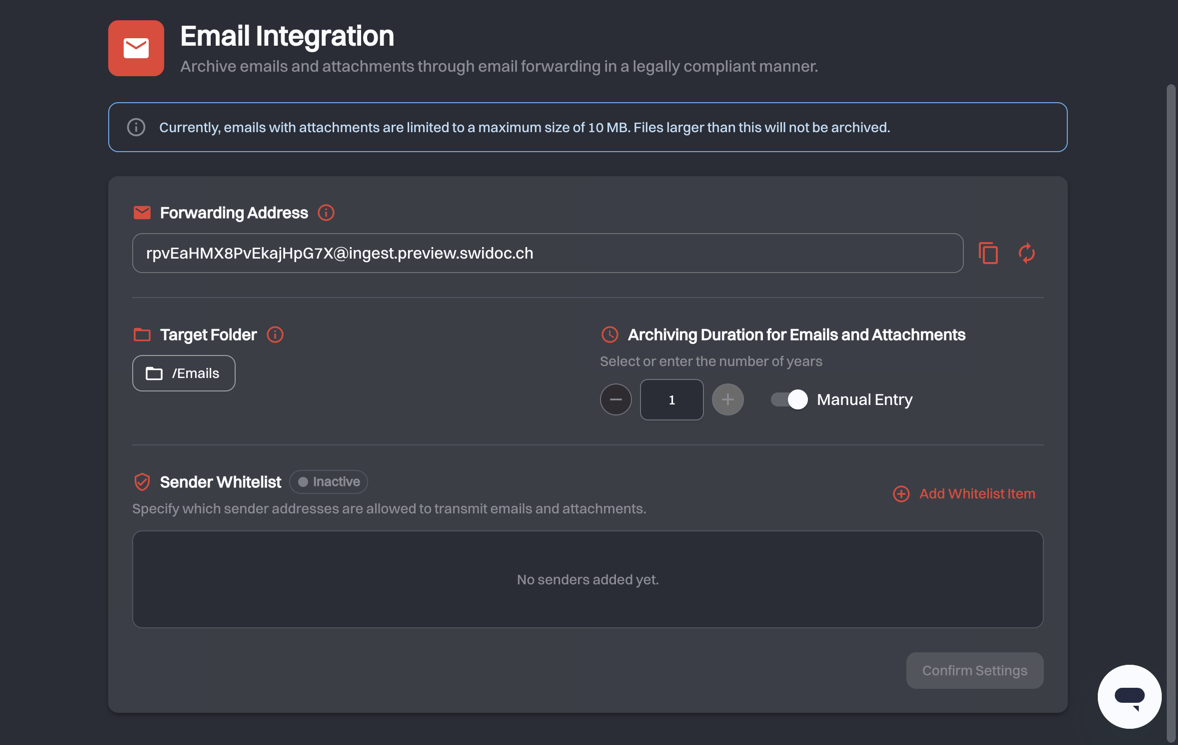
swiDOC archives the email itself as one document and each attachment as a document of its own. They go into a new sub-folder of that folder, named after the date and time the email arrived. Signature files attached to the email are skipped.
Two settings matter before you hand the address out:
- Sender Whitelist: once the list has an entry, only the senders on it may archive, and the list shows
Active. With Add Whitelist Item you allow a single address (
max.muster@your-company.com) or a whole domain (*@your-company.com). - Change Email Address: issues a new address and deletes the old one, which is what you do if the address was misused. The old address stops working immediately.
If Access Management takes your access to the target folder away, emails to the address are no longer archived. swiDOC sends you one email, Emails to your swiDOC address are not being archived, and the Email page shows a warning. Click Select Target Folder for Emails, choose a new folder and click Confirm Settings. Emails that arrived in the meantime were not archived, so forward them again.
If the target folder is deleted, the Email page shows the same warning, and emails go to a folder named
emails at the top level of the archive until you choose a new target folder.
Attachment size limit
Emails with attachments are limited to a maximum size of 10 MB. Anything larger is not archived, so spread large documents over several emails or upload them directly.
# Pebe Live
Video tutorial
Watch the tutorial pebeLive x swiDOC (opens new window) on YouTube.
Pebe Live (opens new window) works like bexio: the same four setup steps, the same status, sync settings and sync history, the same problems, and the same email when a problem stops syncing. swiDOC only reads from Pebe Live and never changes anything there. Configure on the Pebe Live card, or the Pebe Live tab, opens its page. The differences:
- Connecting: Pebe Live connects with an API key. In Pebe Live, open the settings, go to the API page and create an API key. In step 1, Connect Pebe Live, paste it into API key and click Continue. swiDOC checks the key right away and tells you if Pebe Live rejects it. No Pebe Live account yet? links to Create an account.
- Document types: Customer invoices, Credit notes, Supplier invoices and Booking attachments, always all four. swiDOC puts them into sub-folders by type and date inside the destination folder.
- The connected account: the status shows the last four characters of the API key. Replace API key takes the place of Switch account: once the new key is accepted, syncing pauses until you finish the remaining steps, with your settings filled in.
- A rejected key: Pebe Live stops accepting a key that was deleted or renewed there. Create a new key in Pebe Live and enter it with Reconnect Pebe Live. Your settings are kept.
# Via partners & connectors
A partner sets up these connections with you. To connect Proffix (opens new window), click contact Sales on its card. This opens an email to info@swidoc.ch.
If the system you need is not on the page at all, the swiDOC API is the way to connect it. You can also write to us and we will tell you whether a connector already exists.
# Related
- Archive: retention periods and folders, which every integration writes into
- Search: how archived documents are found, including the ones an integration archived
- Access Management: the folder permissions that apply to what an integration archives
- Settings: search attributes and tags an integration can fill in
← Recycle Bin Settings →